
Update 0.4.1 — The Commercial Game
0.4.0 made the driver market a real system. 0.4.1 does the same for the commercial side. Signing sponsors and suppliers is no longer a menu of instant offers — it’s a negotiation campaign you run against the whole grid, on a budget, against the clock. Engines get real architectures you can read on a spec sheet, the paddock’s manufacturers become a world you can browse, and a long list of fixes lands — including a memory leak that could bring a machine to its knees.
⭐ The Marketing app
Sponsors and Suppliers are now one app with five tabs: Sponsors · Sponsor Market · Suppliers · Supplier Market · Missions. One sidebar icon replaces the two, and it follows you through the negotiation window.
Negotiation is a campaign now
Both markets share one Marketing work-unit pool and one 10-turn window (the Sponsors + Suppliers phases combined).
- Pick a target, commit work units, watch it progress. Mission size scales with the partner; a level-1 department fully focused can still land the biggest name, while a strong department negotiates several at once. Reallocate or stop any mission at any time.
- Everyone is racing you. AI teams run missions on the same sponsors and suppliers. Completing a negotiation earns you the deal offer — it then waits, unsigned. Only a signature locks it in: until you sign, a rival who finishes their own negotiation can steal it, and unsigned deals expire when the window closes.
- Know who you’re up against. When a rival opens the same negotiation, their logo appears on your mission card and you get a heads-up email — out-spend them, or fall back to a safe deal.
- Your reach is limited. The Marketing level gates which sponsors you can even see; bigger brands demand a wider network. Sponsors your own department unearths (green dot) come pre-negotiated at 100% — sign them directly, no mission needed.
Suppliers: partnership or client?
Every supplier is a real choice.
- The race is for the exclusive works PARTNERSHIP — it pays you every GP, grants +2 reputation and +5 work-order WU per turn, and locks that supplier away from everyone else.
- Lose the race? A client contract is always available, signs instantly, and your negotiation progress isn’t wasted: it buys up to 20% off the client price.
Contracts now have a length (1–5 seasons)
You choose how many seasons to sign for with a – N yr + selector at signing. How many years a partner will commit to depends on your Marketing department and on how far the negotiation has come — rush a deal early and you’ll only get a season or two; see it through and they’ll offer their best terms.
Engines have architecture
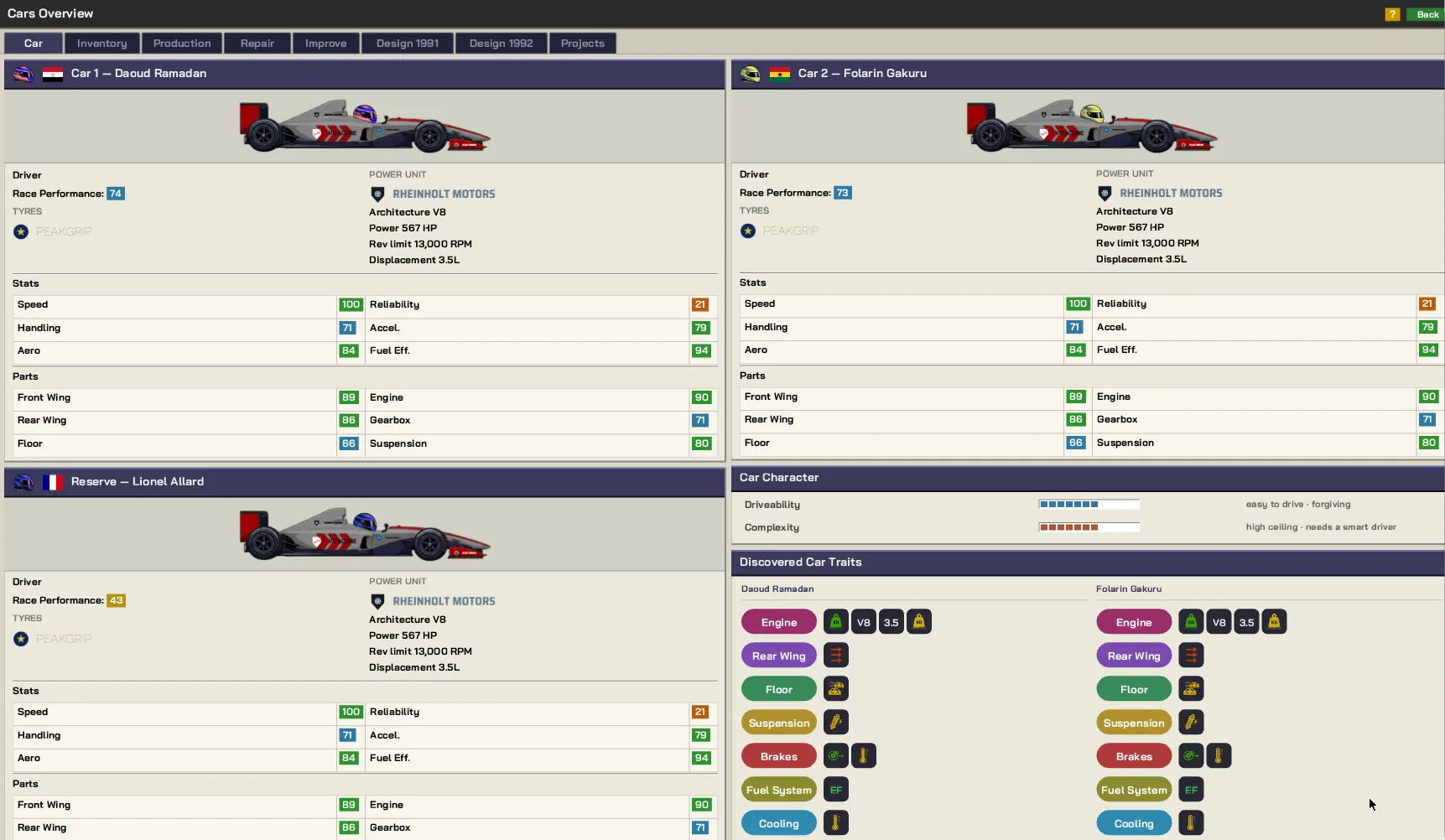
Every PFS engine now runs a real V8, V10 or V12 at 3.5L, shown on a spec sheet instead of abstract bars — and it genuinely drives the simulation.
| Power | Rev limit | Character | |
|---|---|---|---|
| V8 | 500 hp | 13,000 rpm | Cheapest, most reliable, frugal, light — but less driveable |
| V10 | 550 hp | 13,500 rpm | The balanced benchmark |
| V12 | 580 hp | 14,000 rpm | Most power and driveability — thirsty, hot, heavy, fragile, expensive |
- Horsepower drives the car:
base × displacement × condition, feeding straight into the speed model, live and simulated. Fuel burn, heat damage, wear, driveability and AI stint sizing all read the balance. - Architecture and displacement appear as a new white “balance” trait — known from day one, no discovery needed. The race HUD reads
POWERTRAIN (V10 3.5L — 585 HP @ 13500 RPM)and the engine note follows the rev limit. - Choose your motorist carefully: each maker races the architecture it builds on the road. One with no PFS-legal engine in its catalogue still enters — on an adapted V8/V10, at lower quality (marked
*). - My Car → POWER UNIT now shows the real spec sheet.
A world of manufacturers
Every career generates its own paddock of ~35 major road-car makers with a 1990-flavoured country spread, each with a category (Luxury / Sport / Mass Market), a favoured engine architecture and a unique trigram. Browse them in World Data → Manufacturers, and click any of them for a full profile: identity, PFS record, current teams, season history, prestige, valuation and a sector prestige pie. In the constructors’ championship, the Engine and Tyres columns are clickable too — tyre suppliers get their own profile page.
Updated car & suit models
The car and race suit models have been updated to fix the color picker — and you can now also pick the live-2D race livery for your car.
🐛 Notable fixes
Stability
- World Data’s Fame tab could freeze the machine. It warmed a helmet texture for all ~400 drivers in the pool in a single frame — enough of a GPU memory spike to hang the system. Chips are now generated only for rows actually on screen.
Race weekend
- A car with a destroyed part could still start qualifying — the DNS gate was only honoured by the race. Repair or replace the part before quali, or the car sits the session out.
- Engine sound +15%, consistent across free practice, qualifying and race.
R&D
- “Fix a problem” offered fixes on last year’s designs — obsolete specs you can’t even produce, and the engine (which is supplier-rolled and never designable) offering to fix a unit from the previous season. Both gone.
- The Repair tab showed “-100 % penalty” on parts that weren’t destroyed. The scale now runs 0 % (pristine) → 100 % (destroyed), so “-100 %” lines up with the DESTROYED badge.
News & interface
- News headlines and rumours wrap properly instead of spilling out of their card — a rumour naming two scouted drivers now reads on two lines.
- Rival car upgrades and rival commercial deals now appear in the news feed. Previously you only heard about a rival’s deal if they stole a target you were chasing yourself.
- Negotiation emails gained an “Open Marketing → Missions” button.
- Standings row heights are uniform again and the hub’s Drivers panel is vertically centered / Factory Load horizontally centered — fallout from the new text-wrapping engine, now fixed at the root.
- The hub championship table shows a clean top 10.
- Discovered-trait panels (My Car, run plans) show every trait: rows shrink to fit rather than scrolling or clipping.
- Scouting → Past Missions: stopping and restarting an observation no longer creates duplicate rows, and drivers who leave the paddock are removed from the history.
- The negotiation window’s turn counter reads “Turn X/10” across both phases instead of two confusing halves.
Launch
- The animated main-menu circuit now draws from a set of hand-vetted seeds instead of rolling a fresh track at every launch — faster startup, and no more re-roll spinning on a weak GPU.
Try It
0.4.1 is rolling out now to closed-test players, and the free demo on Steam is updated with the same build. Want in on the closed test? Come say hi on Discord.
Play the Demo · Wishlist the Full Game · Join the Discord
— Staz