
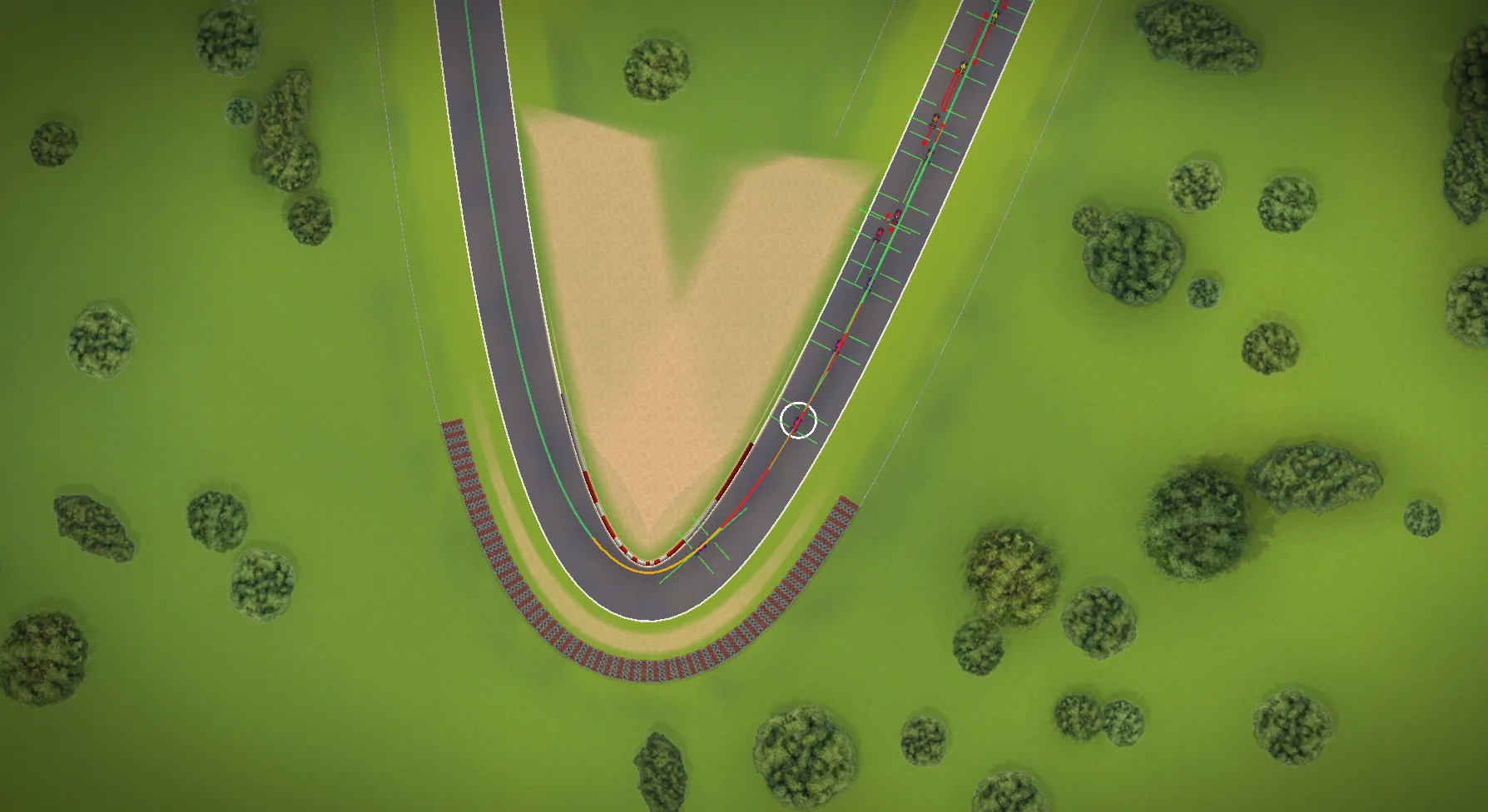
How Every Track is Born
The Undercut generates a new circuit for every race. No two tracks are the same. Here’s how a blank canvas becomes a fully playable F1 circuit in under a second.
Starting with a Circle
Every track begins as a ring of anchor points placed around a center, like numbers on a clock face. Each point sits at a random distance from the center — some pulled inward, some pushed outward — giving the ring an organic, irregular shape.
The number of anchor points controls how many corners the track will have. A high-speed circuit might use 10–12 points, producing long sweeping arcs. A tight technical track uses 16–20, cramming more direction changes into the same space.
One trick makes a huge difference: we deliberately leave a gap between two anchor points. That gap naturally becomes the main straight — the longest, fastest section of track, where the pit lane and start/finish line will live. No special logic needed; the geometry just flows that way.
Smoothing into a Real Track
A handful of anchor points isn’t a racetrack yet. We connect them with a Catmull-Rom spline — a smooth curve that flows through every point without sharp angles. The result is a continuous, flowing circuit that feels hand-designed even though it’s fully random.
The entire path is then scaled up or down so the lap distance matches the target. A street circuit might aim for 3.5 km; a power track might stretch to 7 km. The shape stays the same, just bigger or smaller.
Reading the Corners
Once the path exists, the game “reads” it the way a driver would — by measuring curvature at every point along the track.
Where the path bends tightly, curvature is high: that’s a slow corner. Where the path runs nearly straight, curvature is near zero: that’s a fast section.
From curvature alone, a realistic speed profile emerges:
- A forward pass computes the fastest a car could go at each point, accounting for engine power that fades at high speed
- A backward pass caps those speeds based on how hard a car can brake approaching the next corner
- The result: a smooth speed envelope where cars accelerate out of corners, build speed on straights, and brake hard into the next turn
Each section of track then gets classified as one of three zones: Accelerating (powering out of a corner), Braking (slowing for the next one), or Cornering (navigating the turn itself). These zones drive everything else in the game — tire wear, overtaking opportunities, dirty air effects, and mistake probabilities all vary by zone.
The Racing Line
This is the heart of the system. Real racing drivers follow an outside-apex-outside path through every corner: approach from the outer edge, cut to the inside at the tightest point (the apex), then let the car drift back out on exit. This minimizes the effective corner radius, allowing higher speed through the turn.
The game computes this automatically in two passes:
- Apex pull: where curvature is high, the racing line shifts toward the inside of the corner
- Approach/exit spread: that shift is smoothed over a long distance, which naturally pushes the line to the outside on approach straights and corner exits
The combined result reproduces the classic racing ideal — trail wide, apex tight, exit square — purely from the geometry of the track. Every generated circuit gets a realistic, driveable racing line without any manual tuning.
Placing the Scenery
With the physics figured out, the game dresses the track by observing what the data tells it:
Track width varies with the terrain. Straights are 14 meters wide, giving cars room to run side by side. Tight corners narrow to 11 meters, making the apex feel constrained and precise.
Kerbs appear on the inside of corners — the edge a driver clips when cutting the apex. Their red and white stripes mark the track boundary where cars are most tempted to push.
Tire walls line the outside of corners — where a car would end up after losing control. The wall height scales with danger: a slow hairpin after a fast straight gets tall, dense tire barriers. A gentle kink barely gets a single row.
Sand traps spread in front of tire walls and inside tight corners, providing a buffer zone that slows cars before they hit the barriers. Their depth follows the curvature — deepest at the apex of the tightest corners, tapering to nothing at entry and exit.
Grandstands fill the long straight sections, placed on the outer side where spectators would have the best view of cars at full speed.
Barriers (metal railings) run along the outside of moderate-to-fast corners, skipping grandstand and sand trap areas where they’d be redundant.
None of these placements are scripted. They all emerge from reading the same curvature and speed data that defines the racing experience.
The Pit Lane
Once the main straight is identified (the fastest, longest section), the pit lane is constructed as a parallel road offset to one side. Entry and exit transitions are smoothed with ease-in/ease-out curves so cars can merge naturally rather than turning sharply off the racing line.
Pit stalls are spaced evenly along the usable middle section, and the pit lane connects back to the track with a gradual merge that mirrors real-world circuit design.
Track Characters
The career mode features four types of circuit, each defined by just two numbers: how many corners and how long the lap is.
| Character | Corners | Lap Length | Personality |
|---|---|---|---|
| High-Speed | 10–12 | 5.5–8 km | Flowing arcs, long straights, engine power matters most |
| Technical | 16–20 | 3–4.5 km | Tight hairpins, constant direction changes, driver skill shines |
| Street | 13–16 | 3.5–5 km | Mix of fast straights and tight chicanes, precision rewarded |
| Balanced | 12–16 | 4–6 km | A bit of everything, well-rounded challenge |
The same generation algorithm produces all four — the personality emerges naturally from the parameter choices. More corners in a compact space creates a technical feel. Fewer corners with longer distances creates a power circuit. The physics and scenery placement adapt automatically.
Quality Control
Not every random seed produces a great track. The generator runs a quick validation after each attempt: is the main straight between 800 and 1400 meters? Is the overall shape reasonable? If not, it rolls a new set of random points and tries again. Most tracks pass on the first or second attempt.
The Result
In under a second, from a handful of random numbers, the game produces:
- A smooth, continuous circuit with realistic proportions
- A full speed profile that dictates where cars go fast and slow
- Zone classification that drives every aspect of the racing simulation
- A natural racing line that follows real-world driving principles
- Kerbs, tire walls, sand traps, grandstands, and barriers — all placed where they belong
- A pit lane with smooth entry and exit
- Procedural grass, asphalt, and sand textures that tile seamlessly
Every race on a new track. Every track with its own personality. All from geometry and physics, nothing hand-placed.